Case study · Personal project
Ristretto, my microfiction app
From a functional prototype for reading to a production web app built with AI and integrated with Contentful as its CMS.
Initial idea validation, research, MVP, functional prototype, production web app, and CMS integration.
Search, navigation, and discovery flows designed for an intuitive experience.
Card sorting, heuristic evaluation, and usability testing with real users to refine key decisions.
Situation
Recovering the reading habit in the scroll era
As part of the UX/UI Design course at Coderhouse, I developed my own product idea from an increasingly common problem: many people wanted to get back to reading, but found it hard to sustain long works within routines shaped by speed, social media, and fragmented attention.
That is how Ristretto was born: a microfiction app designed for brief reading moments, discovering authors, and recovering the reading habit through a logic more compatible with real patterns of use.
The concept comes from ristretto, the short coffee variant made with the same intensity as an espresso but extracted with half the water. The proposal is to enjoy literature the same way: through brief reading with concentrated flavor.
Task
Design a literary discovery experience
The challenge was to design an MVP that helped people discover, explore, and save microfiction quickly and intuitively, prioritizing brief reading moments and low-friction navigation.
The proposal brought together curated works from different literary genres and made them searchable by title, keyword, or author, in addition to filters, related recommendations, and favorites for rereading.
The goal was to turn the desire to read more into an experience that felt simple, accessible, and compatible with real usage patterns.
Action
From research to a functional prototype
The project combined research, information architecture, and iterative design to build a discovery experience centered on reading and adapted to brief moments of use.
The initial benchmark revealed an opportunity for a Spanish-language microfiction app with curated content and more agile navigation than existing alternatives. From there, I defined the MVP, the main flows, and the navigation architecture.
- Reading-app benchmark and validation of the product idea.
- Definition of proto-persona, POV, and the MVP's priority features.
- Information architecture, card sorting, and navigation flow design.
- Evolution of wireframes, UI kit, and functional prototype in Figma.
- Heuristic evaluation and moderated usability tests with 10 real users to detect friction points and iterate the experience.
User testing helped identify concrete improvement opportunities, especially around onboarding, labels, and understanding the “Discover” and “Library” modes.
Later on, I picked the project back up to turn the prototype into a functional web app using Lovable, GitHub, Visual Studio Code, and the terminal.
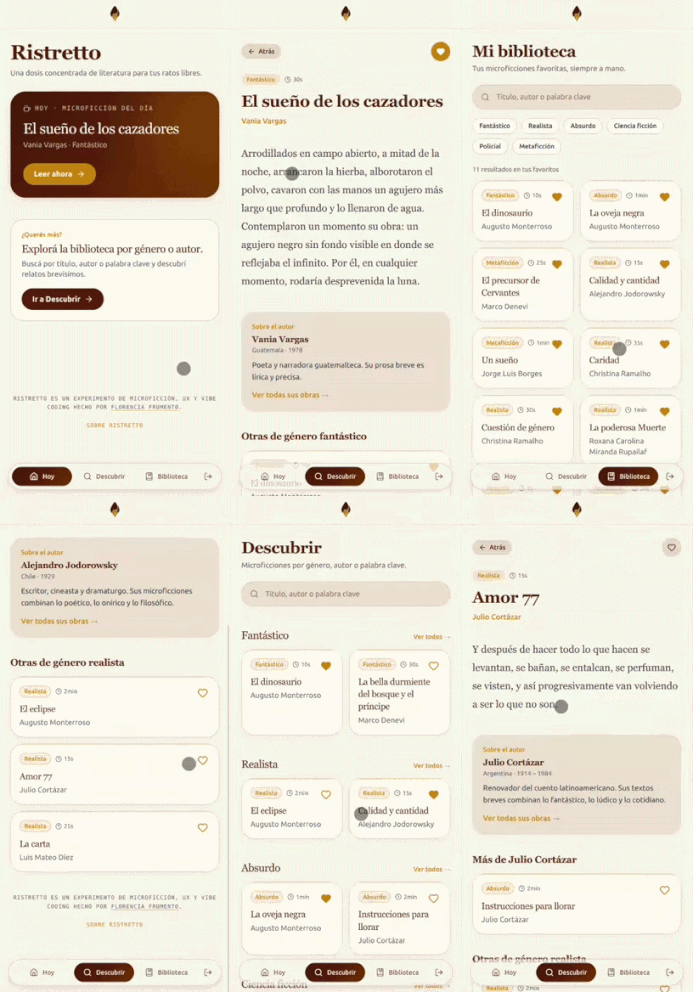
In a later stage, I added Contentful to separate the reading experience from content management. I first validated the flow by publishing a new microfiction entry from the CMS and, once the integration worked, migrated the full library so Ristretto could grow as an editorial product without depending on direct code changes.
Result
A validated MVP brought to production
Usability tests showed that the main discovery flow worked correctly: people could search for microfiction, explore results, and access works without significant friction.
At the same time, testing revealed concrete opportunities for improvement in onboarding, microcopy, and understanding the “Discover” and “Library” modes, which helped refine the experience with greater clarity.
The most important learning came later: a project that began as research, MVP, and UX/UI prototype ended up becoming a functional web app with a more flexible editorial foundation: microfiction entries can be managed from Contentful, published, and updated without touching the frontend.